 WeMates
We take care of room allocation at your student residence.
Few things shape a student's year as much as their roommate. We get to know every resident through a survey on habits, schedules and personality, and pair them with the roommate they fit best. You save weeks of manual work and keep the final say on every pair.
- Double rooms: we prevent problems between roommates.
- Single rooms: we prevent problems with the neighbours.
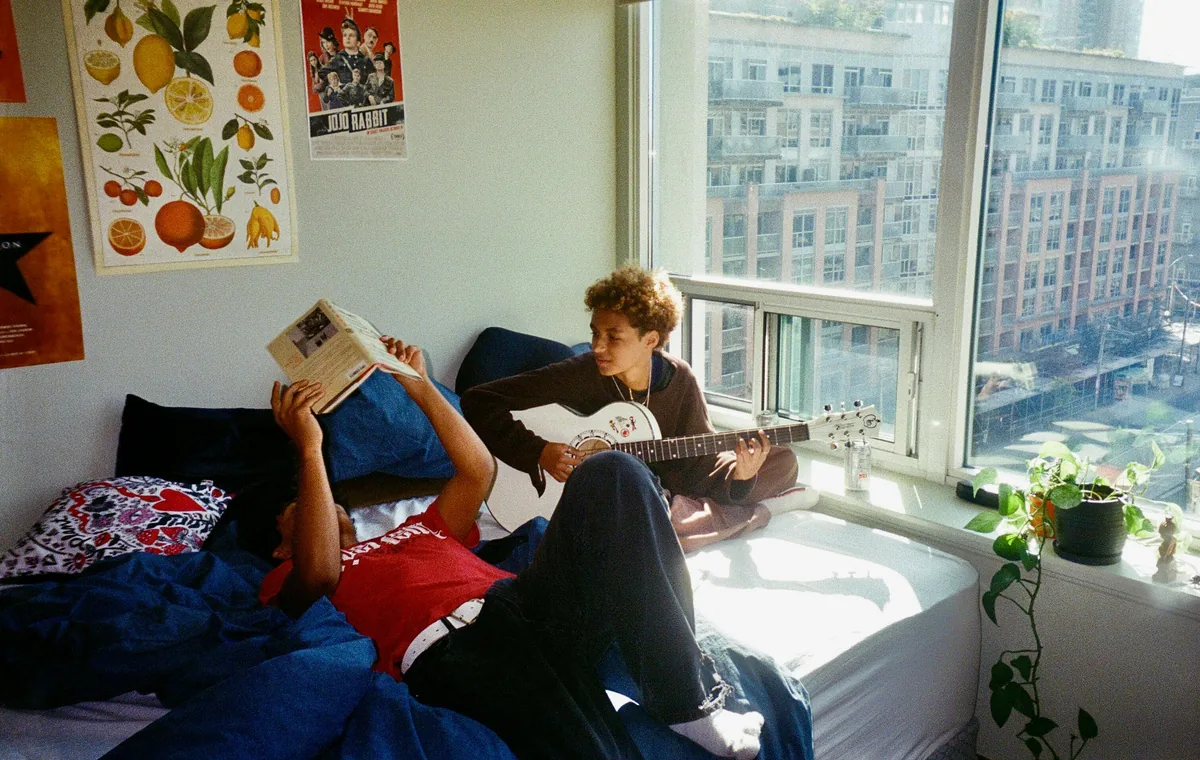
The problem we solve
Deciding who shares a room with whom takes the team weeks, and even then the decision is made blind: degree, home region and age say nothing about whether two people will get on. We know what does. We measure it across twenty dimensions and allocate an entire building in seconds.
What happens when rooms are allocated by hand
6.7/10
is the average score students give the roommate their residence assigned them.
But the average doesn't tell the whole story: more than 1 in 4 give a score below 5.
54%
of students have had a conflict or an argument with the roommate they were given.
And in half of those cases, what they do to fix it doesn't work.
What happens to the student
- They arrive in September not knowing who they'll share a room with
- and end up with someone on a different schedule
- who keeps them awake on weeknights
- and it ends up showing in their grades
And that's only the part you can see. None of the students we interviewed asked the residence management for help: they talked it over with their roommate, let it go or moved on their own. Nobody at reception ever knew there was a problem.

And what happens to the residence
- A complaint in October
- that forces a room change, and moving a third person
- that ends in a place that isn't renewed
- and in a review that damages your residence's reputation
Filling a place again costs more than keeping it: marketing, viewings, paperwork. Add the more than 100 hours a year spent making the allocation work, and what looks like an August task is costing you money all year round.
I had to ask for a room change after six months. With my second roommate there were problems too, because she didn't clean.
 Age 20 · double room
I'd walk into the room and the smell was unbearable. My roommate had no hygiene at all. The following year I left the residence.
 Age 20 · double room
We were very different and had a big fight. I had to move out of the residence.
 Age 21 · double room
I had to move my mattress into a friend's room and live with them.
 Age 20 · double room
He studied architecture and got up early to make models, sometimes at night too, and I couldn't sleep properly.
 Age 20 · double room
I'd come back to the room and there'd be people in there drinking.
 Age 21 · double room
I ended up with someone who didn't talk to anyone and never left the room. We never got on, and I spent the whole year without feeling comfortable in my own room.
 Age 19 · double room
If I'd had a good experience, I'd still be in a double room and living at the residence.
 Age 22 · double room
They don't tell you who you'll be sharing with until you get to the room.
 Age 23 · two years in a residence
I was very lucky with my roommate, but I did know people who had problems.
 Age 19 · double room
The biggest fear of anyone booking a shared room is not knowing who they'll live with. Being the residence that can answer that is a competitive advantage, and with WeMates you have it before other residences do. Don't get left behind.
How does our product work?
From the signed contract to the assigned room. Click any stage to see what happens behind it and what you get from it.
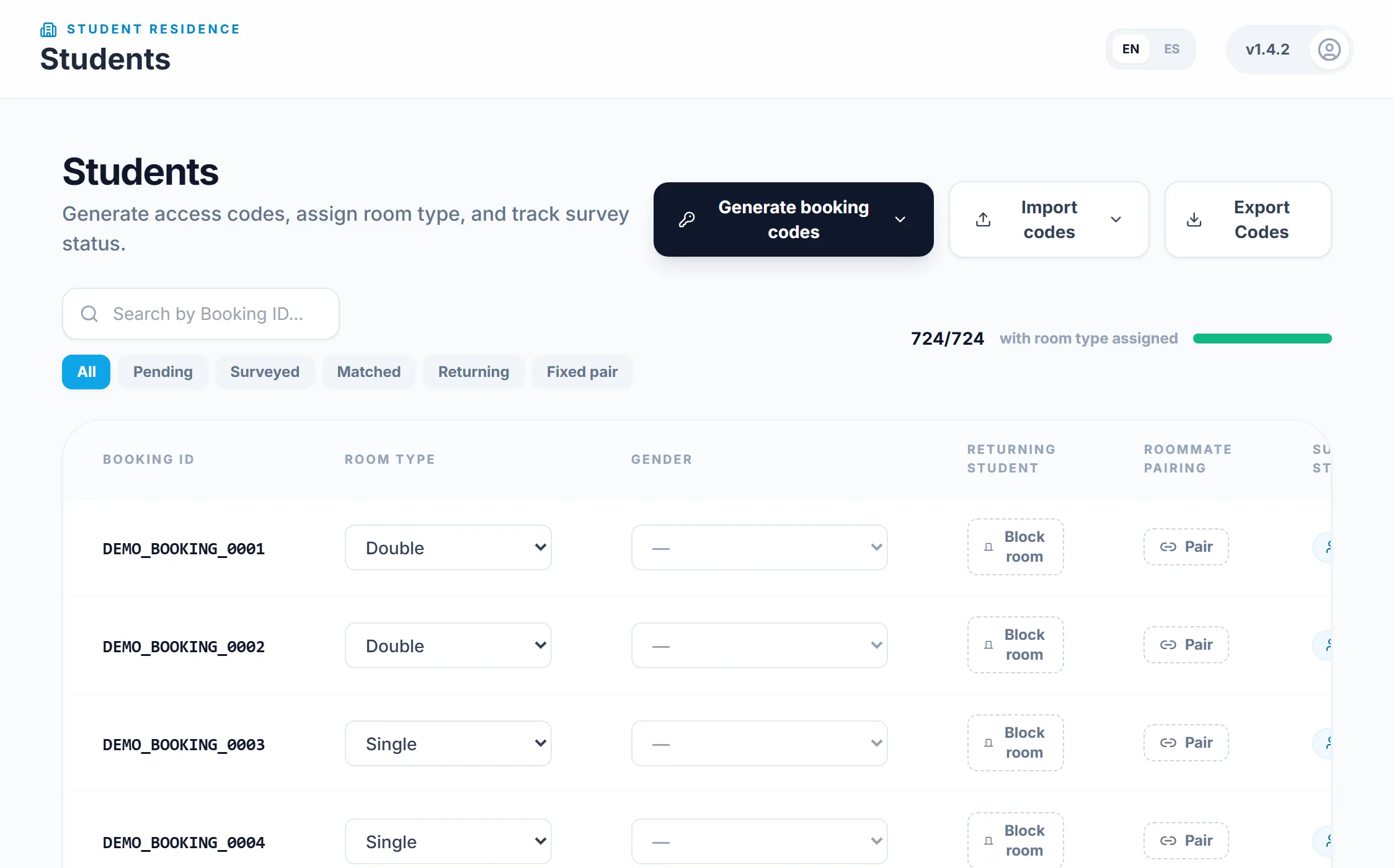
You upload your list with what each student has booked
You upload your list as a CSV or Excel file with the bookings and their room type, and mark who is returning or already has a room assigned, and who is coming with a roommate of their choice. The room inventory is loaded only once, when the account is set up.
What you get
Nothing to migrate. Your team keeps its tools and its process. WeMates only decides who goes with whom and in which room, based on how well they fit.
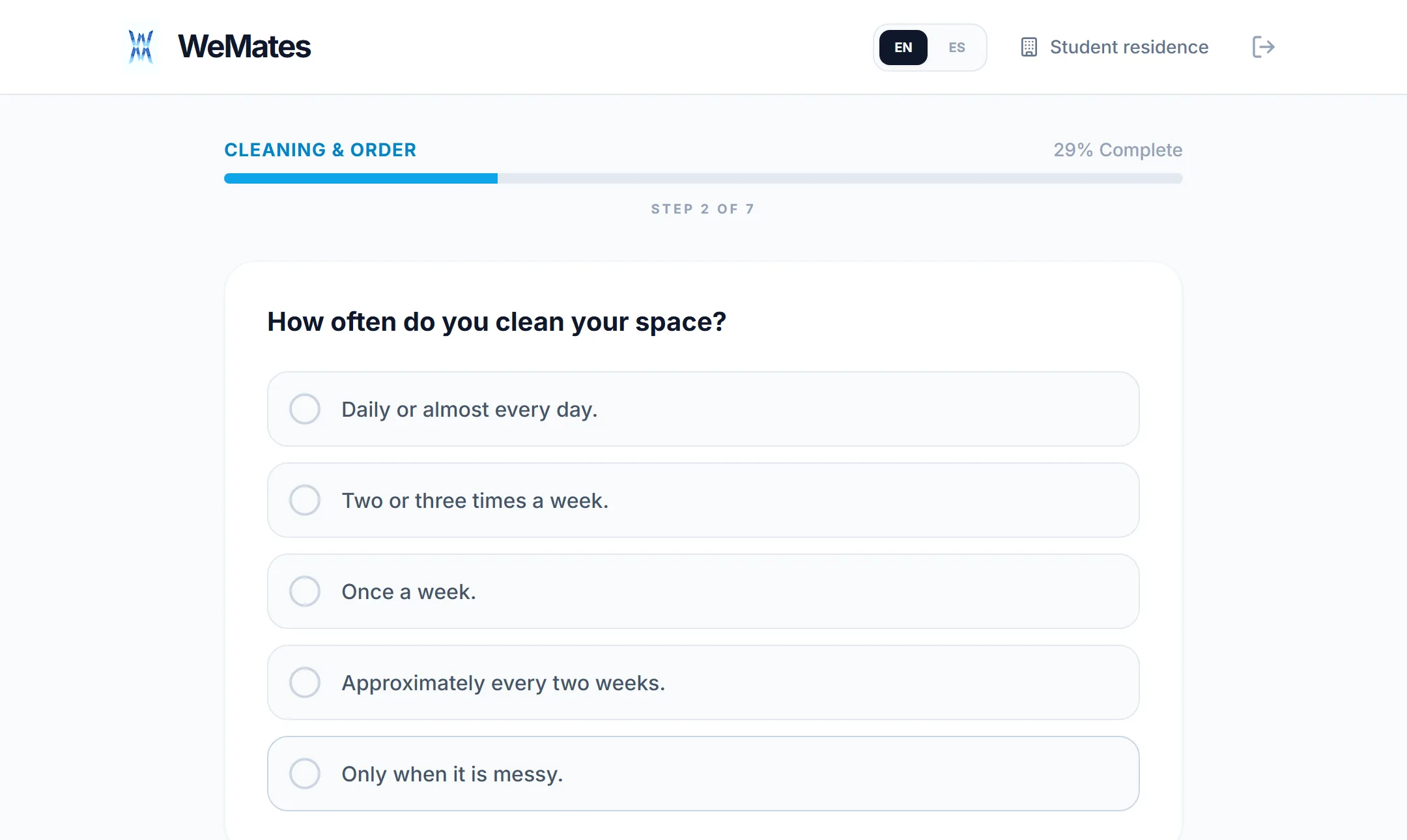
Get to know how each resident lives
Once their place is secured, each student logs in with a code (their own booking code, or one generated by WeMates), without giving a name or an email, and answers 20 behavioural questions and 5 open ones. We want the most honest answer possible, so we ask about habits rather than about how people see themselves.
What you get
Students take part in choosing who they live with. They know their roommate wasn't drawn by lot, and at the first friction they talk before asking for a move.
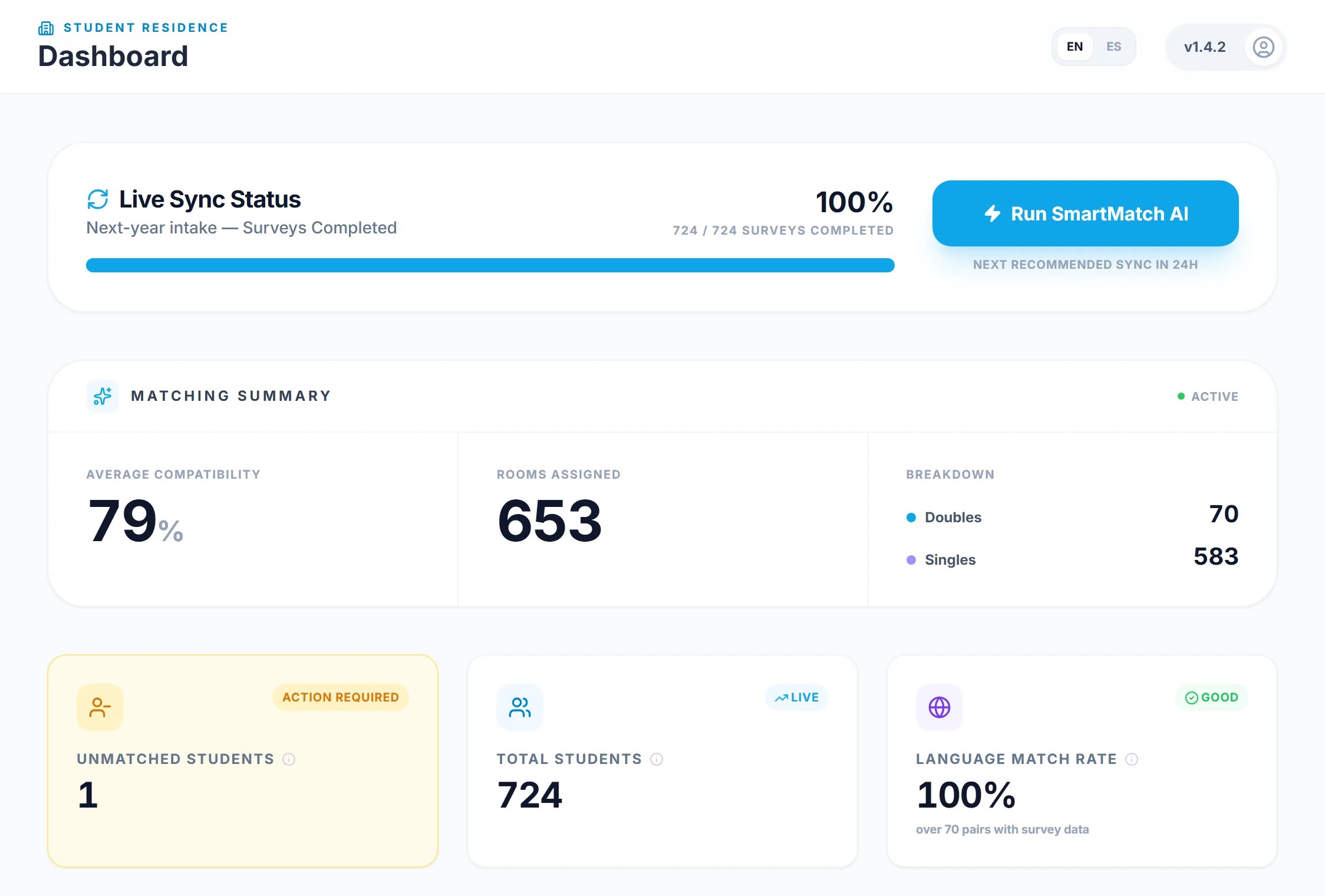
Compatibility for every room
We decide both who shares a room and which rooms go next to each other: a single room with noisy neighbours causes as many problems as two roommates who don't get on. Your gender policy, a shared language and whatever was already decided are always respected, since returning residents usually keep their room or come with a roommate of their choice.
What you get
We choose the most compatible combinations across the whole building, to keep problems in the residence to a minimum. It is calculated for the entire building in seconds.
See the reason behind every pair
You see where the two fit and where they clash, dimension by dimension, with the clash flagged before it happens. You can swap who goes with whom, lock a pair so it doesn't change, or approve the allocation. Nothing goes ahead until you approve it.
What you get
The reason behind every pair, on record. When a student complains in November, you can see what the two had in common and what was flagged from the start.
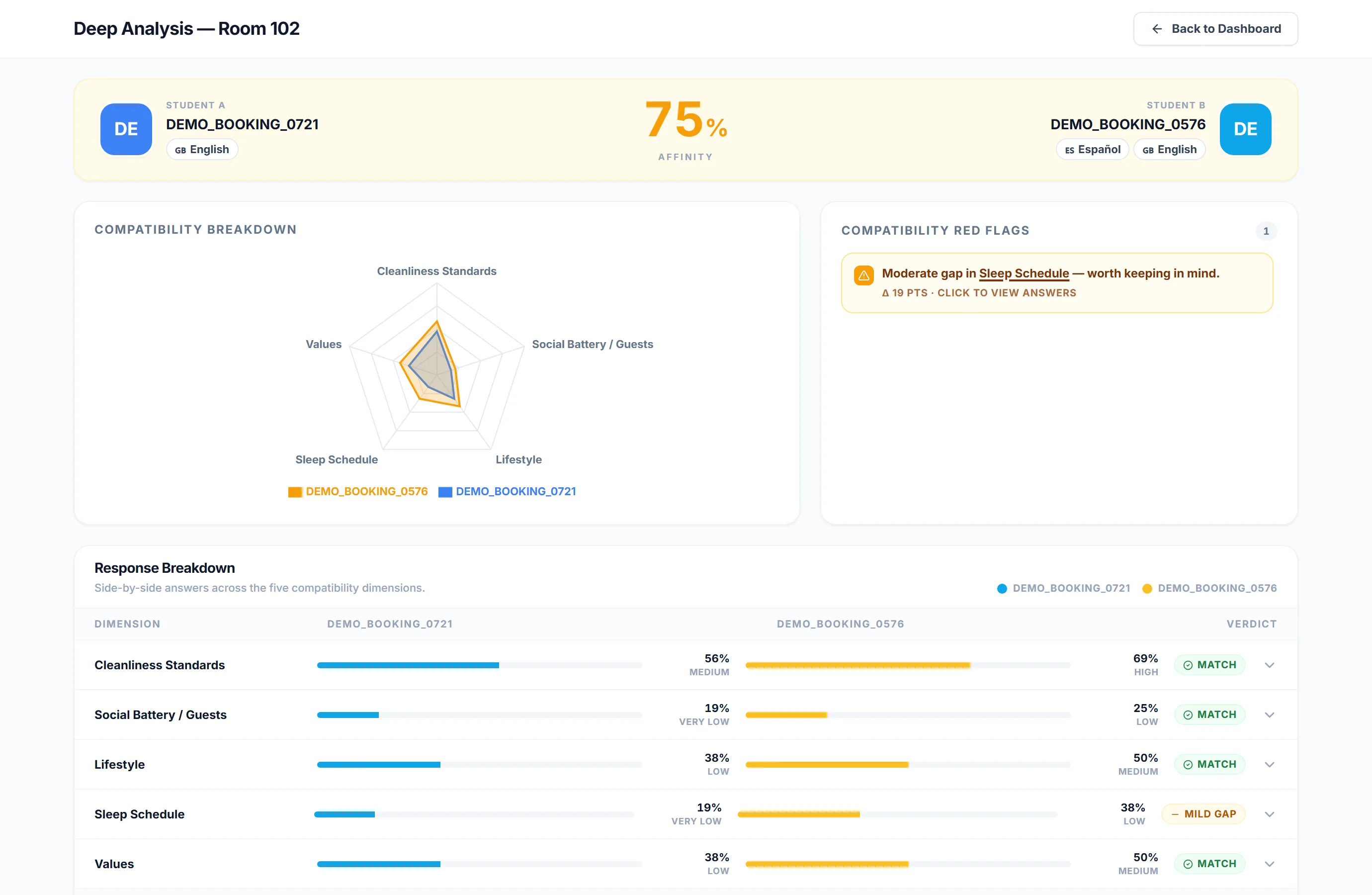
We've been through this too. In many residences the walls are thin and you hear everything, so we aim to give neighbouring rooms, double or single, similar schedules and noise habits.
What we measure, and why
The survey doesn't ask about tastes. Each dimension comes from a named model, and it is there because it predicts a specific source of friction in shared living.
Cleanliness is one of the things people who live together clash over most, and standards vary a lot from one person to the next. That's why we don't ask how people see themselves. We ask about concrete habits.
For some people the room is a private sanctuary, for others a social club: everyone needs a different amount of people and noise around them. The problem starts when the two see it differently.
An early bird and a night owl clash at very specific moments: one wants to sleep while the other still has the light on, or one gets up very early and wakes the other. That broken rest is often behind conflicts in the room and, in the most serious cases, behind a request to move.
Day-to-day routines and the use of shared things: smoking, food in the room, weekends away. Small details that, repeated two hundred times, stop being small.
The way each person handles a disagreement matters as much as what the disagreement is about. That's why we take each person's conflict style into account, so that two very different ways of dealing with it don't end up colliding.
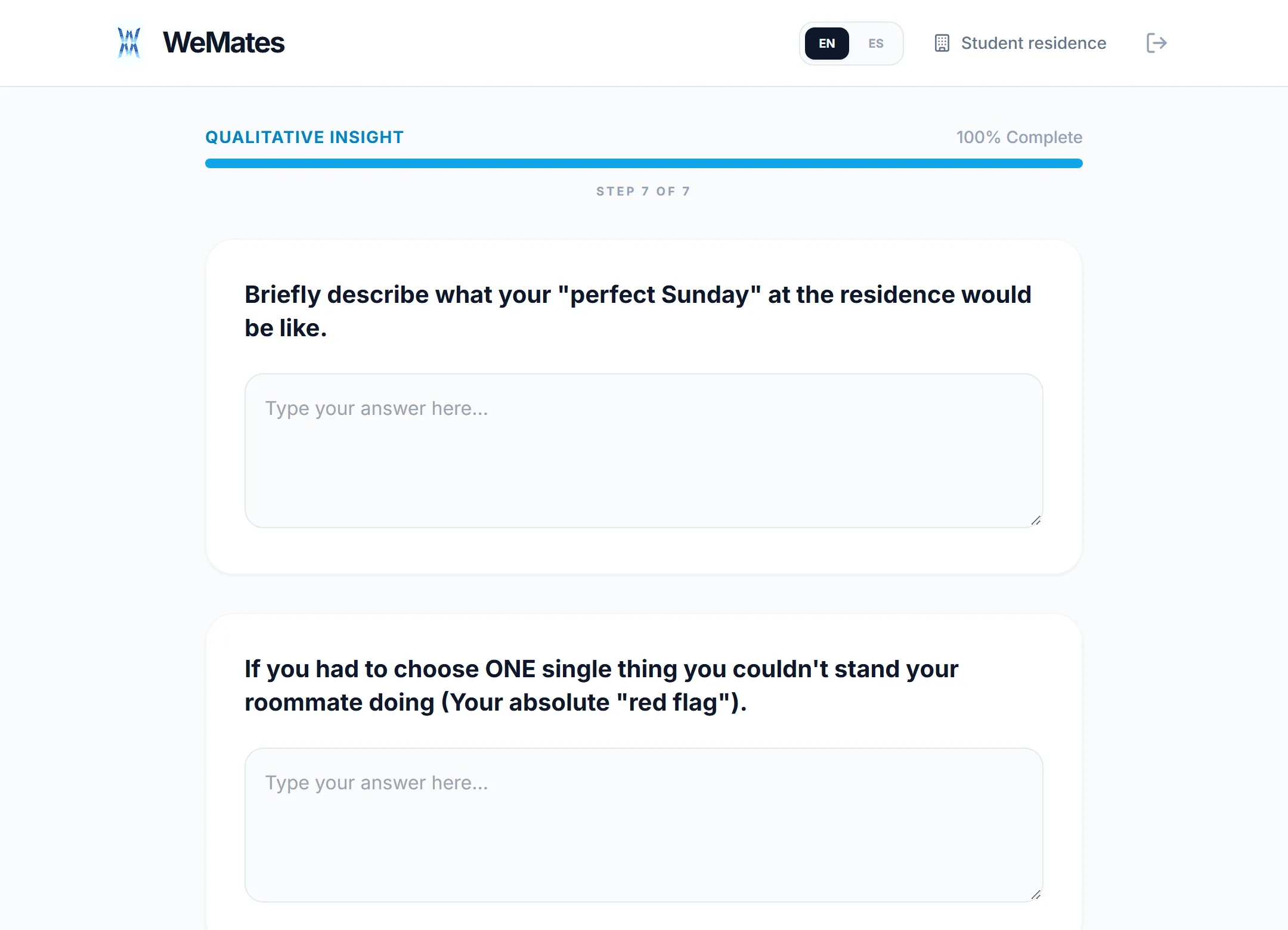
5 open questions to tell us who you are
The only ones with complete freedom to talk about what they love and what they couldn't stand in a roommate, beyond their habits.
- What would your perfect Sunday at the residence look like?
- What is the one thing you couldn't stand your roommate doing?
- What kind of relationship do you expect to have with your roommate?
- What do you need from your environment during exam season?
- What hobby or habit should your roommate know about?

Salamanca · 2026-27 academic year
The year that was allocated in an instant
The Colegio Mayor de Oviedo, part of the University of Salamanca, already had who gets in settled: the university awards places by academic grades with a system of its own. What was still done by hand was deciding who shares a room with whom, using the only clues available: same degree, same home province, similar age.
In July 2026 WeMates did that allocation. 278 students, an entire building, a full academic year. The result was 74 double rooms, which means 148 people paired, and 130 single rooms. All 278, with nobody left without a place.
The entire allocation, all 278 of them, was calculated in under 10 seconds.

- Returning residents kept the same room
- Those who arrived with a roommate of their choice, whether siblings, friends or people from the previous year, stayed together
- The Colegio Mayor's rule of pairing within the same gender was respected
Sometimes you put two people together and it goes fine, they get on politely, and during the year they don't ask for a room change or have any problems. But maybe, if they had been matched with richer data, you would have found a better person for each of them. And maybe you'd get two friends out of those roommates.
 Pablo Ramos Hernández
Deputy director of the Colegio Mayor de Oviedo ·
interview from March 2026, before the first allocation · translated from Spanish
This is the problem WeMates solves.
The academic year is under way
At the Colegio Mayor, room changes cluster in the first fifteen days of each semester. We have asked them for that figure so we can compare it with the previous year's.
We will publish it here as soon as we have it, whatever it shows.
Read the full caseAbout us
We are Óscar Grau and José Pablo del Moral. We started WeMates in 2024, while we were students at Universitat Ramon Llull, after seeing up close what spending a whole year next to the wrong person does to someone.
What made us look beyond our own experience was a friend. He lived in a double room in a beautiful, well-run residence, the kind that gets shown off proudly on move-in day. And every time we went to see him, the room smelled bad. When he talked about that year he never mentioned the building. He talked about the person sleeping two metres from his bed. The following year he left the residence.
We started asking around and kept finding the same thing. When people have a bad year, it is almost never the residence. It is who they were placed with. And hardly anyone tells reception. We are still at it for the same reason we started: so that the student who arrives in September doesn't have to endure the year, and you don't have to fix it in October.

Living together shouldn't be a lottery.
Students are looking for connection. Residences are looking for efficiency. WeMates brings the two together.
Contact us